
Alcohol: Rehab & Recovery

Medically Reviewed By: Dr. Claire Wilcox, M.D., Dec 2, 2019
Updated: October 16, 2020
In 2016, one in four Americans drank heavily at least one time during the year (heavy drinking is defined as four drinks at a time for women, and five for men). Additionally, there were over 30,000 deaths in 2014 directly involving alcohol.
Unfortunately, only 20% of those who abuse alcohol will ever get help. Part of the reason that many people choose not to get help may be the blurred lines between socially acceptable drinking and alcoholism. While any usage of illegal drugs is considered a problem, a certain amount of alcohol usage is considered normal and acceptable. For more information about how much alcohol is safe to consume and how to tell if you or a loved one qualify as having an alcohol use disorder, read our guide to alcohol addiction.
While Alcoholics Anonymous (AA) is the most-well known method of alcohol rehab, there are other options that are often more effective for those with a serious problem. For instance, many people are not aware that medications for alcohol addiction exist. Read on for a complete look at how to get help for an addiction to alcohol.
Guide to Alcohol Rehab
TABLE OF CONTENTS

The Basics of Alcohol Rehab
Whether attending rehab for a drug addiction, an alcohol addiction, or both, the rehabilitation process is the same. However, medication for alcohol addiction is a component that’s often added to the detox and therapy stages, which are shown below.
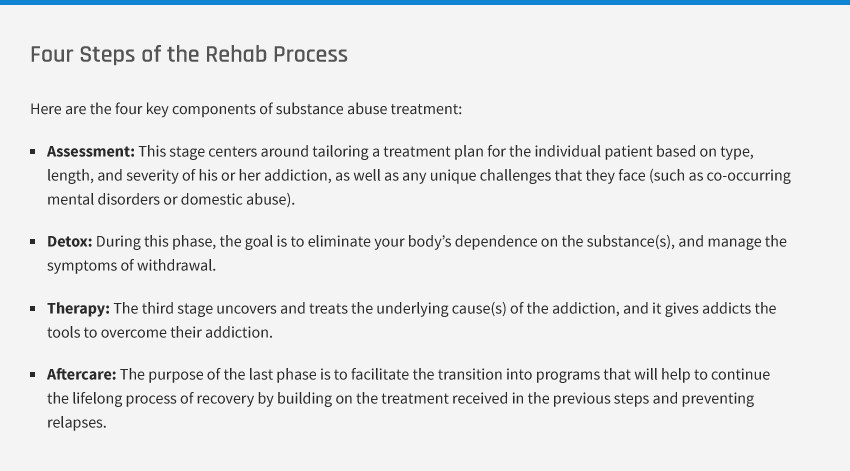
For more information, read our guide to the rehab process
Rehab Settings
The different types of rehab facilities fall into two categories or “settings.” The two settings are inpatient (full-time rehab) and outpatient (part-time rehab). Inpatient means the client lives at the facility, and each step of the rehab process is typically completed there. Patients who attend an outpatient facility return home after treatment each day and often complete the steps of rehab at different facilities. Below is a comparison of the most common program options within those two rehab settings.
Overview of Treatment Settings
| Setting | Type of Treatment | Description | Time Commitment | Duration |
| Inpatient | Short-term residential | Intensive treatment, sometimes in a hospital setting. Therapies offered are extensive. Medical treatment is available to those who qualify. | Hours per Day: 24 | 14-30 days |
| Days per Week: 7 | ||||
| Long-Term Residential | Intensive treatment in a non-hospital setting, most often a therapeutic community facility with other patients. Therapies offered are extensive. Medical treatment is available to those who qualify. | Hours per Day: 24 | 3-12 months | |
| Days per Week: 7 | ||||
| Partial Hospital- ization |
Intensive treatment in a hospital setting. Patients do not stay overnight. Referred to as “inpatient” due to the hospital setting, extensive services provided, and the near full-time commitment every week. Medical treatment is available to those who qualify. | Hours per Day: 6-8 | 14-30 days | |
| Days per Week: 5 | ||||
| Outpatient | Intensive Day Treatment | Patients receive the extensive services of an inpatient program but return home after. After completion, patients often transition to less intensive counseling. Therapies offered are extensive. Medical treatment is available to those who qualify. | Hours per Day: 2-4 | 3-4 months |
| Days per Week: 3 | ||||
| Counseling | Both individual counseling and group counseling focus on short-term behavioral goals to develop coping strategies. Therapies offered are moderate. Medical treatment is not available. | Hours per Day: 1-2 | As long as desired | |
| Days per Week: 1-3 | ||||
| Support Groups | Self-help groups are recommended to help maintain abstinence after another form of treatment. Typically meet one day a week for 1-2 hours. | Hours per Day: 1-2 | As long as desired | |
| Days per Week: 1 |
Alcohol Rehab Demographics
The Substance Abuse and Mental Health Services Administration (SAMHSA) found that patients who identify alcohol as their only substance of abuse made up 19% of admissions into rehab in 2015, while another 15% of admissions were for those who primarily misuse alcohol but use other drugs as well.
Assessments for Alcohol Addiction
Anyone who is concerned they may have a drinking problem should receive an assessment
Professional assessments are always the best first step towards recovery, and they are especially important for anyone who feels they may have a problem with drinking. Since alcohol is legal, and drinking is culturally acceptable, many people who have an AUD (alcohol use disorder) might not realize the extent of their problem. Criteria for the diagnosis of AUD include craving, spending lots of time to obtain or use the substance, reduced effect of the substance with repeated use (tolerance), withdrawal symptoms, persistent desires or efforts to reduce or stop using the substance, negative impacts of use on relationships with family and friends, physical health, or job performance; use in dangerous settings, etc. A professional assessment is the only way to be sure.
Contact your family doctor or an addiction professional
Since those with moderate to severe alcohol addiction can benefit from medication that must be prescribed by a medical professional, start with your primary care physician. He or she can start the assessment process, work with an addiction-trained provider to provide the right prescriptions, if needed, and monitor your overall health during the recovery process. Alternatively, you can contact a counselor or rehab facility directly to schedule an assessment and begin the rehabilitation process.
For more information on alcohol addiction and the assessment process, read our guide on alcohol addiction.
Detox for Alcohol Addiction
Whether you decide on inpatient or outpatient rehabilitation, detox is an essential beginning step towards recovery. Because of the potentially serious medical concerns of alcohol withdrawal, we recommend professional detox (rather than quitting cold turkey at home). Detox can be completed in an inpatient or outpatient facility depending on the severity of the addiction and any medical complications that are present.
For more information about the specifics of detox, read our guide to drug and alcohol detox facilities
Withdrawal Symptoms
Regularly using alcohol leads to physical dependence. When a person stops using alcohol, the brain reacts negatively to the chemical imbalance, leaving the user with the side effects of withdrawal.
Most people only have mild to moderate withdrawal symptoms
For most people, withdrawal symptoms are only moderate or mild and disappear within 2-7 days of the last drink. In these cases, the symptoms are unpleasant, sometimes dangerous (such as elevated heart rate and blood pressure), and can be complicated by other addictions or medical problems. Therefore, it is wise to be evaluated by a medical professional during alcohol withdrawal to assess the severity and whether or treatment (often with a benzodiazepine such as Librium) is required. Sleep aids (e.g. trazodone, mirtazapine, hydroxyzine) can also help with insomnia. Because many people with AUD also have thiamine deficiency, which, if left untreated, can lead to brain damage (causing dementia and balance difficulties), it’s wise to ask your doctor for thiamine pills during detox.
A small number of people may experience life-threatening symptoms
For 5-10% of those undergoing alcohol withdrawal, a serious complication called delirium tremens (DT) can occur, which is potentially fatal – more so for those with serious medical conditions or those who don’t receive treatment. Those with a long history of heavy drinking or previous experience with alcohol withdrawal are at a higher risk of DT. Symptoms of DT include hallucinations, disorientation, tachycardia, hypertension, hyperthermia, agitation, and diaphoresis.
Withdrawal-associated seizures also occur in 5-10% of those undergoing withdrawal. Generalized tonic-clonic convulsions usually occur within 12 to 48 hours after the last alcohol consumed but can occur after as few as two hours of abstinence. Seizures are seen more often in people with a history of chronic alcoholism, and often start in the fourth or fifth decades of life.
Alcohol’s Withdrawal Symptoms
| Body | Mind | |
| Common Withdrawal Symptoms |
|
|
| Less-Common Withdrawal Symptoms |
|
N/A |
| Delirium Tremens (DT) Symptoms |
|
|
For more information about withdrawal, read our guide on Alcohol Addiction
Detox Medications
There are three FDA-approved medications that are typically prescribed during the detox process and are used throughout the therapy process to support recovery. For more information, read our section on therapy for alcohol addiction below.
Therapy for Alcohol Addiction
Therapy is the third step in the rehab process, sometimes intermingling with the second phase (detox). Therapy deals with the root of the addiction and is crucial for long-term success.
The method that’s proven to be most effective in treating alcohol addiction is to use medications alongside traditional behavioral therapy. However, medications are underutilized in alcohol addiction treatment, and many people are not even aware that they exist. Behavioral therapy involves individual or group counseling, and it equips addicts to overcome their addiction by giving them coping skills and addressing any other mental health needs.
Medication Therapy
The FDA has approved three medications to use in alcohol addiction treatment. All three are non-habit forming and can be used long-term to help prevent relapse back into alcohol abuse. The three drugs approved by the FDA are:
- Naltrexone: Naltrexone makes drinking less pleasurable and reduces craving by blocking opioid receptors, and it has been shown to reduce relapses for some people. It also may reduce the amount that people drink when they drink. Vivitrol is an extended-release version that is administered once a month by injection.
- Acamprosate: Also known by its brand name (Campral), acamprosate reduces withdrawal symptoms such as insomnia, anxiety, restlessness, and dysphoria. It also reduces relapse risk. Acamprosate is especially useful for addicts who are heavily dependent on alcohol.
- Disulfiram: Disulfiram (Antabuse) interferes with the way a person’s body process alcohol, and produces a very unpleasant reaction that includes flushing, nausea, and palpitations. This prevents people from drinking when they know they’ve taken it. However, it only works if people take it regularly, and patients sometimes neglect to take the medication, which limits its usefulness. Disulfiram is most effective when administered under supervision, such as by a spouse or clinic.
Other medications with evidence for efficacy in AUD, but which are not FDA approved for AUD relapse prevention include topiramate, gabapentin, alpha-1 adrenergic receptor antagonists (prazosin, doxazosin) and varenicline.
Psychiatric care
Comorbid depression and anxiety can negatively impact recovery. Medication and counseling for these comorbidities can significantly improve outcomes.
Behavioral Therapies
Also referred to as “counseling,” behavioral therapies involve one-on-one or group therapy with a certified professional in order to change the behaviors that lead to alcohol abuse. The National Institute on Alcohol Abuse and Alcoholism (NIAAA) list four features that most behavioral therapies share:
- Developing the skills needed to stop or reduce drinking
- Helping to build a strong social support system
- Working to set reachable goals
- Coping with or avoiding the triggers that might cause relapse
While there are quite a few behavioral therapies that can be used to treat alcohol addiction, the NIAAA recommends the following four options:
- Cognitive–Behavioral Therapy: This form of therapy is focused on helping patients to avoid relapse by identifying each person’s unique “triggers,” or feelings and situations that lead to heavy drinking, and managing stress. The goal is to help patients develop the skills necessary to cope with situations that lead to problem drinking.
- Motivational Enhancement Therapy: This therapy is a short-term approach that aims to increase a patient’s motivation to engage with addiction treatment by identifying the pros and cons of seeking treatment, forming a plan to make changes, and building the skills needed to stick to the plan.
- Marital and Family Counseling: Since alcohol abuse often deeply impacts the family of the addict, this type of therapy incorporates spouses and other family members in the treatment process and can play a large role in repairing relationships damaged by the addiction. When done properly, it builds up the patient’s support system and increases the chances for long-term recovery.
- Brief Interventions: This approach consists of short one-on-one or small-group counseling sessions. The counselor provides information about the individual’s drinking pattern and potential risks, and he or she works with the client to set goals and provide ideas to make positive changes.
In addition, 12-Step Facilitation, a type of therapy that compliments Alcoholics-Anonymous (AA) meeting attendance has been found to be as effective as CBT and MET for alcohol use disorder, in previous studies.
Aftercare for Alcohol Addiction
According to the NIAAA, relapse is common among those who are recovering from alcohol addiction. Without aftercare (the final step in the rehab process), relapses may escalate from a small setback, to a total return into alcohol abuse and dependence. The most commonly-known form of aftercare is Alcoholics Anonymous (AA), but there are many other options that are outlined below.
Over half of all admissions into treatment programs are a result of relapse
While the exact percentage of patients who have relapsed after treatment for alcohol addiction isn’t known, data from treatment facilities shows that 57% of those admitted into treatment programs (for alcohol use disorder only) have previously been treated. For those with a secondary drug addiction, about 70% are there as a result of relapse.
Relapse Rates by Drug Type 2015
There are four main factors that cause addicts to relapse
- Stressful situations
- Lack of a positive support system
- Triggers (events that “trigger” positive memories or feelings of using the substance)
- Unaddressed mental health issues
Ongoing Counseling
Patients often choose to maintain a relationship with a counselor and continue treatment less frequently in an outpatient setting. Even meeting once a month can be helpful in staying accountable and continuing to make progress towards long-term recovery.
Mutual-Support Groups
One of the most common forms of aftercare is mutual-support groups, such as AA. Since AA’s approach faith-based, 12-step approach isn’t right for everyone, other types of support groups are also available. Whatever option you choose, regularly attending groups can help you maintain abstinence by providing a support system with positive relationships from which to draw encouragement.
Click your state from the list below to find AA meetings near you
To find Alcoholics Anonymous meetings near you, click on your state from the list below. From there you will be able to find the local organization that coordinates the meetings. They will be able to provide the most up-to-date information about the time and location of meetings, as well as the contact information for group leaders.
- Alabama
- Alaska
- Arizona
- Arkansas
- California
- Colorado
- Connecticut
- Delaware
- District of Columbia
- Florida
- Georgia
- Hawaii
- Idaho
- Illinois
- Indiana
- Iowa
- Kansas
- Kentucky
- Louisiana
- Maine
- Maryland
- Massachusetts
- Michigan
- Minnesota
- Mississippi
- Missouri
- Montana
- Nebraska
- Nevada
- New Hampshire
- New Jersey
- New Mexico
- New York State
- North Carolina
- North Dakota
- Ohio
- Oklahoma
- Oregon
- Pennsylvania
- Rhode Island
- South Carolina
- South Dakota
- Tennessee
- Texas
- Utah
- Vermont
- Virginia
- Washington
- West Virginia
- Wisconsin
- Wyoming
Finding Rehab forAlcohol Addiction
Our directory of rehab programs includes a comprehensive list of available treatment centers and programs as provided by the Substance Abuse and Mental Health Services Administration (SAMHSA). In the directory, you will find tools to filter the programs by setting, price, and location.
Find out more by reading our guide to Choosing the Right Rehab
Click your state from the list below, then input your zip code to find rehabs near you
- Alabama
- Alaska
- Arizona
- Arkansas
- California
- Colorado
- Connecticut
- Delaware
- District of Columbia
- Florida
- Georgia
- Hawaii
- Idaho
- Illinois
- Indiana
- Iowa
- Kansas
- Kentucky
- Louisiana
- Maine
- Maryland
- Massachusetts
- Michigan
- Minnesota
- Mississippi
- Missouri
- Montana
- Nebraska
- Nevada
- New Hampshire
- New Jersey
- New Mexico
- New York State
- North Carolina
- North Dakota
- Ohio
- Oklahoma
- Oregon
- Pennsylvania
- Rhode Island
- South Carolina
- South Dakota
- Tennessee
- Texas
- Utah
- Vermont
- Virginia
- Washington
- West Virginia
- Wisconsin
- Wyoming
Take Action
Alcohol addiction is notorious for hurting families and relationships, but it can be overcome if you are willing to seek help. To find out more about finding the highest-quality facilities, read our guide on Choosing the Right Rehab.
Whether researching for yourself or a loved one, read more about the chemistry of alcohol addiction and how it affects the human body and mind.
Disclaimer: The information contained on Help.org is for informational and educational purposes only and should not be relied upon for any medical or diagnostic purpose. The information on Help.org should not be used for the treatment of any condition or symptom. None of the material or information provided on Help.org is not intended to serve as a substitute for consultation, diagnosis, and/or treatment from a qualified healthcare provider.